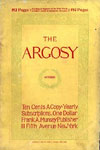


About the Project
The Pulp Magazines Project is an open-access digital archive dedicated to the study and preservation of one of the twentieth century's most influential literary & artistic forms: the all-fiction pulpwood magazine. The Project also provides information on the history of this important but long neglected medium, along with biographies of pulp authors, artists, and their publishers. The site launched in July 2011, and has received over 1,500,000 page views from 192 countries around the world.
At the heart of the Project's mission is the archive itself. In July 2011, it began with a modest library of five representative first-generation titles from the early 1900s. As of March 2017, this number had grown to include over 400 individual issues, representing 85 different titles from the United States, England, and Australia. Over time, the archive will continue to expand, as new magazines are digitized, and new contextual materials added. Eventually, it will feature a broad range of pre-1923 titles, post-1923 titles where copyright has lapsed, and full volume runs of select titles from 1896 to 1946.
The Project is dedicated to fostering ties between communities of collectors, fans, and academics devoted to pulp magazines, and will offer opportunities for research and collaboration to both scholars and enthusiasts alike. We will provide information on upcoming conferences and conventions, and promote new working relationships between academics and the hundreds of pulp fans, scholars, and collectors beyond the college and university.
Mission Statement
Pulp originally referenced the quality of these magazines' paper: using coarse, untreated paper made from wood-pulp kept production costs low, allowing large shipments of the magazines to be distributed and sold as cheaply, and as far away, as possible; or, without advertising. It was an incredibly successful formula; by 1915, 8 best-selling titles had the combined monthly circulation of 2.7+ million copies—an estimated readership of 15% of the U.S. population. For more information on pulps, see Mike Ashley's 'The Golden Age of Pulp Fiction,' R.D. Mullen's 'Pulps and Big Slicks,' and other materials collected here on the Project's website, or linked to from its Books & Essays page.
Despite their enormous influence, two significant factors would help contribute to the pulps' marginal status as literary and cultural documents in departments of English, funding for humanities, and academic scholarship today. Materially, pulp magazines epitomized the ephemerality of popular twentieth-century print culture: on par with advertisements, movie posters, comics, and newspapers. Their success also correlated with mass-production and marketing techniques; challenging institutional notions of culture's place outside economic spheres.
Libraries at several major research institutions across the United States and Canada do contain substantial holdings of pulp magazines, including the U.S. Library of Congress, UCLA (Black Mask), Syracuse University (the Street & Smith archives), and Texas A&M University (Weird Tales). There are also two major collectors' conventions held each year in Chicago and Columbus, OH. The archives are relatively few and far between; the conventions scarcely provide an environment conducive to research. The Project hopes to, in part, address this problem of availability and accessibility of primary documents for the fans, scholars, and bibliographers of pulp magazines around the world.
Partnerships
The PMP archive of digitized magazines consists of full-text, cover-to-cover scans produced in collaboration with a variety of partners. Represented in the archive are periodicals scanned by the PMP, Pulpscans Group, Scanrus, Digital Pulp Preservation, Newsstand: 1925, Conrad First, and others. All scans are made directly from the original pulp-paper magazines, have been cross-checked against multiple sources to ensure integrity, and are stored and shared across multiple servers to maintain long-term availability and use.
Getting Involved
If you are a scanner and have any magazines that may be of interest, actual or digital—and that you are willing to donate to the Project—it would be greatly appreciated. Or, if you would like to contribute a biographical note (approx. 500 words) to the website's database, email us here: info@pulpmags.org.
You can also support the Project through a monetary donation in the amount of your choice. Donations will be put toward the costs of servers, bandwidth, software, maintenance, and the ongoing development of the site. These secure transactions are handled by PayPal, but you do not need a PayPal account.
Statement of Copyright
The materials in the digitized magazines linked to this website are for non-commercial, educational purposes only. To the best of our knowledge, they are out of copyright or are presented in a limited capacity for good faith. If you or anyone you know owns the copyright to the periodicals, material, or photographs included here, please contact us. Otherwise, all photographs & pulp images on the website are the © copyright of their respective owners.
Contact Information
For questions or comments, email us here: info@pulpmags.org.
Or connect with us on  _
_ _
_ _
_ _
_